Gary's StoryStack
Today . . . and tomorrow . . and . . .

On this day — July 24 — in 1956, an eight-year-old girl named Rosanne Abramo, living in a working-class, Italian section of Brooklyn, asked her mother a question:
“Isn’t that awful, what happened to those two ships that ran into each other?”
Her mother said, “Nothing like that has happened, Rosanne. Wherever did you get such an idea?”
The next night, in a dense fog off the coast of Nantucket Island, the Swedish ocean liner Stockholm struck the starboard side of the Italian ocean liner Andrea Doria. Forty-six people from the Andrea Doria died; from the Stockholm, five. The Andrea Doria capsized and sank. Many ships rushed to the scene to help; 1,660 passengers and crew survived.
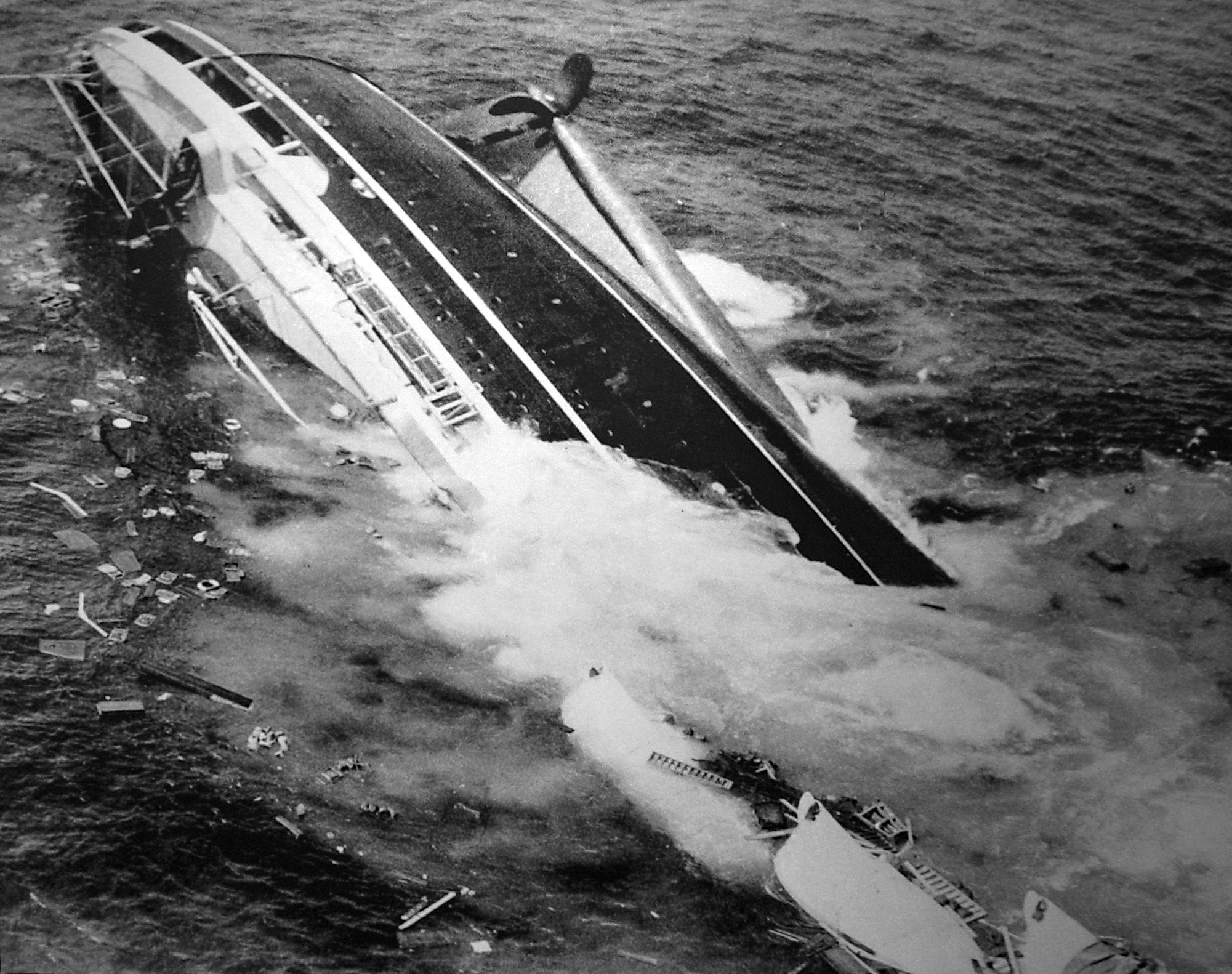
When word got out about little Rosanne’s premonition, the New York City Board of Education wanted to test her mental capacities. But her father, a longshoreman, and her mother, a seamstress, were frightened by what Rosanne had sensed, and they refused to allow any tests.
Rosanne went to a public high school and to college, and 16 years after the ocean disaster, she told a friend that her parents’ reaction had so upset her that she made a stark decision: to tamp down any further premonitions she felt arising.
Still, always curious, she was a voracious reader and questioner.
I met Rosanne when our public TV station was producing a nightly newsmagazine series, with not even one working-class person on our staff. How do you cover the life and times of a diverse city like New York without the sensibilities of people with different experiences from the majority’s?
Our executive producer deputized me to generate working-class candidates to hire. I called Ralph D’Angelo, the director of a nonprofit agency devoted to promoting the quality of life of working-class people, and asked him to assemble a cross section of young people – white, Black and Latino – who might qualify to be hired for on-the-job training as reporters.
Ralph assigned the task to his executive assistant – who turned out to be Rosanne. She recruited about 20 candidates, all seated around a long conference table at the agency when I arrived to listen to them talk about themselves and their communities. Rosanne sat in with them to make them feel welcome.
When the meeting ended, and the candidates left, I walked into Ralph’s office and apologized for what I was about to tell him: The only person at that conference table who I believed had what it would take to succeed as a reporter and producer was . . . Rosanne.
She had never expressed any interest in working in television, but every word out of her mouth matched what we were looking for.
I thought Ralph would bristle, but he instantly said, “If that’s something she wants to do, she goes with my blessing.”
When I made the offer to Rosanne, she was surprised. She hesitated a moment, then said, “I’d like to try.”
So, we hired her. Her first day at the station we gave her an on-camera test, to see if she had the potential to report on the air. We sat her down and told her to look right at the camera. She said, “Which one is the camera?”
From that humble beginning she eventually became an Emmy Award-winning producer who indeed brought a different sensibility to our broadcasts. Among her accomplishments: a sparkling profile of Coney Island’s Italian neighborhood, and a documentary on the state of the labor movement.
Rosanne also cultivated contacts in a group called the National Congress of Neighborhood Women, formed to give voice to working-class women — a response to the feminist movement, which catered to middle- and upper-class concerns. Working-class women needed support for tenant rights, preservation of their communities, and opportunities for higher education where they lived.
In Rosanne, those women saw a champion.
A bunch of us co-workers often went to lunch together at a Greek joint near the TV station. Rosanne told great stories and quickly became so popular with our crew that she earned the right to be awarded a nickname: Roxy.
She told us about a bunch of juvenile delinquents she grew up with who hung out on street corners angling for hustles. One day they sat the weakest member of their group on a curb, with one leg sticking out so that a delivery truck would run it over and they could collect an insurance settlement.
The “accident” worked out as they had planned.
Except . . . there was a problem: A guy who used to hang out with them in high school had become a cop. Standing across the street, he saw what they were doing, and he arrested them.
Roxy had an ambition: to work in Hollywood for the super producer Norman Lear, of All in the Family fame. When she heard about an entry-level opening in his company, she sent an application letter to his office, so eager for it to get there fast that she dispatched it for overnight delivery by a new start-up company called FedEx.
That letter cost her $85. And it got her nowhere.
So, she moved to Los Angeles, got a job at the CBS station, then moved over to the public station where I was working, and proceeded to produce one great story after another.
Within three years, Roxy married, and she and her husband, Vinny Ventola, a gifted artist and writer, were hired by . . . Norman Lear. They developed a series about Sunday dinners at the home of a multi-generational Italian family.
Roxy and Vinny wanted to start their own family, but they could not conceive. And they couldn’t afford in vitro fertilization . . . until Norman Lear and his wife Lyn, who had come to adore them, paid for it. Roxy delivered a daughter, Miranda Rose.
Life was great. The tiny home they rented in Los Angeles was bursting with art and books and record albums and ideas and friends.
Until — unexplainably — Vinny developed AIDS, and he died. Next, the baby developed AIDS, and she died. Roxy was left alone . . . and devastated.
Then, Roxy developed AIDS.
But instead of collapsing in grief, she became a powerful and unrelenting activist, leading three organizations to fight for federal funding for AIDS research. And, with great good humor, she kept encouraging others with the disease not to give up living as fully as possible, for as long as they could.
In the three years she lived after her diagnosis, she wrote and produced stage plays that shone the light on the callousness of the government, the cost in lives lost, the cost to survivors, the cost to the community.
Roxy also wrote a screenplay about her life with Vinny and Miranda Rose, called And Then There Was One. She produced the movie, which starred Amy Madigan as Roxy. It was broadcast on Lifetime TV in March 1994, to excellent reviews.
Eight months later, Roxy died, at the age of 47.
The community fighting AIDS continues to revere her. Just the other day a former colleague in the anti-AIDS movement recalled her as “a fierce warrior.”
I recall her as the dearest kind of friend: a brilliant, funny, straight-talking, loyal and adventurous soul.
* * *
Thank you for being here. If you find that the stories here touch you, please encourage friends, family members, and associates to subscribe, at:
garygilson.substack.com
Cheers,
Gary
It's hard to pull off inspiring and heartbreaking in the same story -- beautifully told
Thanks Gary G for another enjoyable heart warming story from your life experience. Happy to read this during a siesta here in 100 degree weather having lunch in Air Conditionings in Mission SD, about 30 minute drive from our WiWang Wacipi (sundance) with our Sicangu Lakota Relatives and more. Mitakuye Oyasin! We are all related. In Gratitude, Tom W